Help another preacher grow without starting every review from scratch.
They submit their own sermons and keep their own library. The Sermon Coach gives them a practical coaching debrief. You see the full evaluation, recognize patterns across sermons, and walk into the mentoring conversation knowing where to focus.
It makes the mentoring conversation more specific, more consistent, and more useful.
What changes when you mentor with The Sermon Coach
Better-prepared conversations
Spend your time on the preacher's highest-leverage development need instead of diagnosing everything from scratch.
The Sermon Coach brings structured evidence and a consistent framework. You bring what you know about the preacher, his congregation, his context, his calling, and his character.
Patterns across sermons
One sermon may reveal a problem. Several sermons show whether it is recurring, improving, or tied to a particular text or occasion.
You read the evaluations side by side over months and notice what one review never could.
Coaching without taking ownership away
The preacher accepts the relationship, submits the sermon, reads his feedback, and keeps his library.
You bring the wisdom, encouragement, and judgment that software cannot provide.
How the relationship works
Six steps, and most of the work happens in the conversation, not the software.
Invite a preacher you are developing. An associate, a church planter, an intern, or a lay preacher in your church.
He accepts and submits his own sermon. Nothing is visible to you until he accepts. The sermons are his, in his own account.
He reads the feedback his seat provides. A coaching debrief and How It Preaches on Apprentice. The full evaluation on Colleague.
You read the full evaluation. Every seat gives you the complete picture, sermon after sermon.
You meet around one practical focus. One thing to work on before the next sermon, not eleven.
You decide when the score will help. On Apprentice, the scored evaluation waits for you. Release it when it will serve his growth rather than distract from it.
What he reads on Monday morning
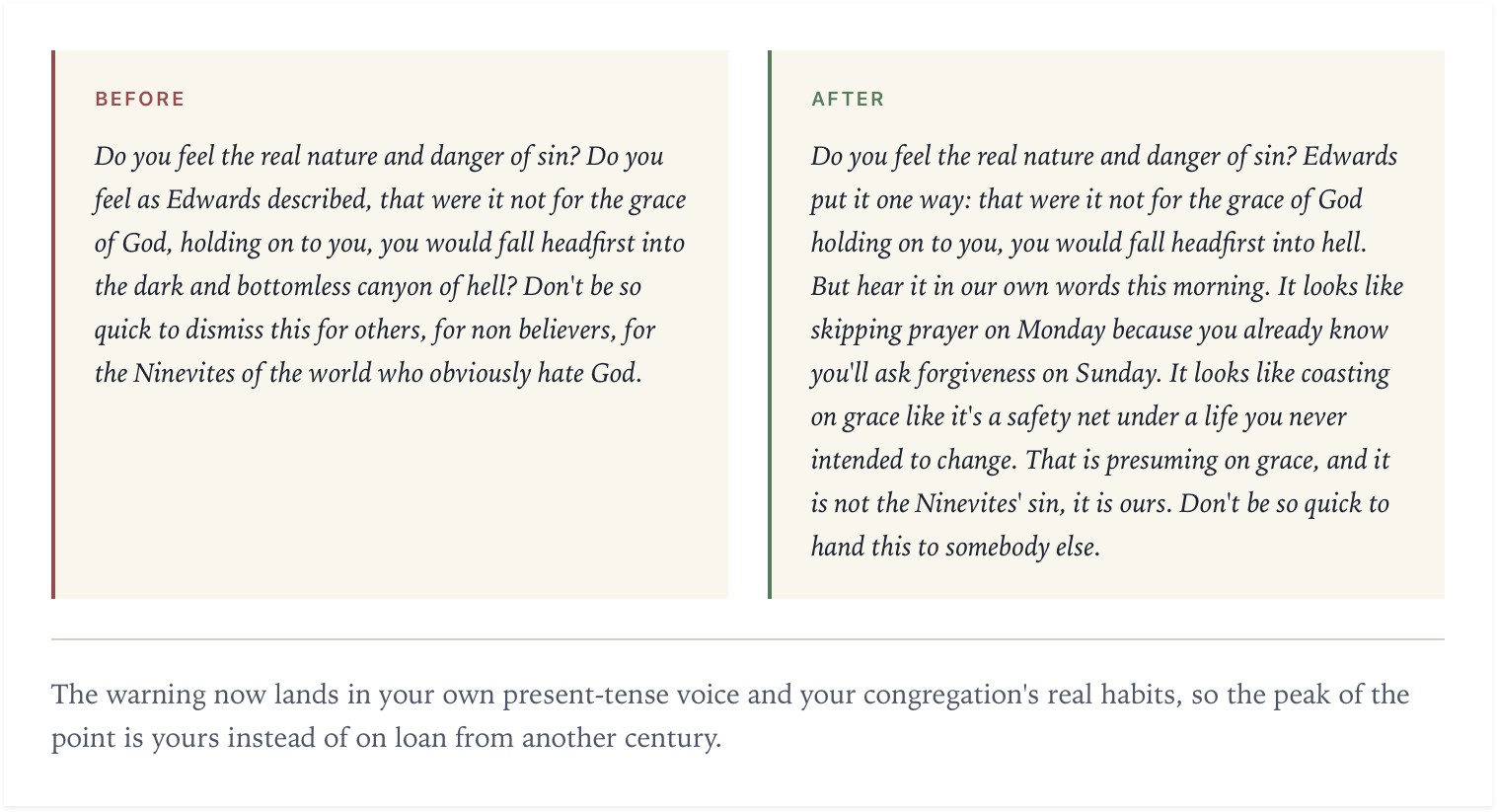
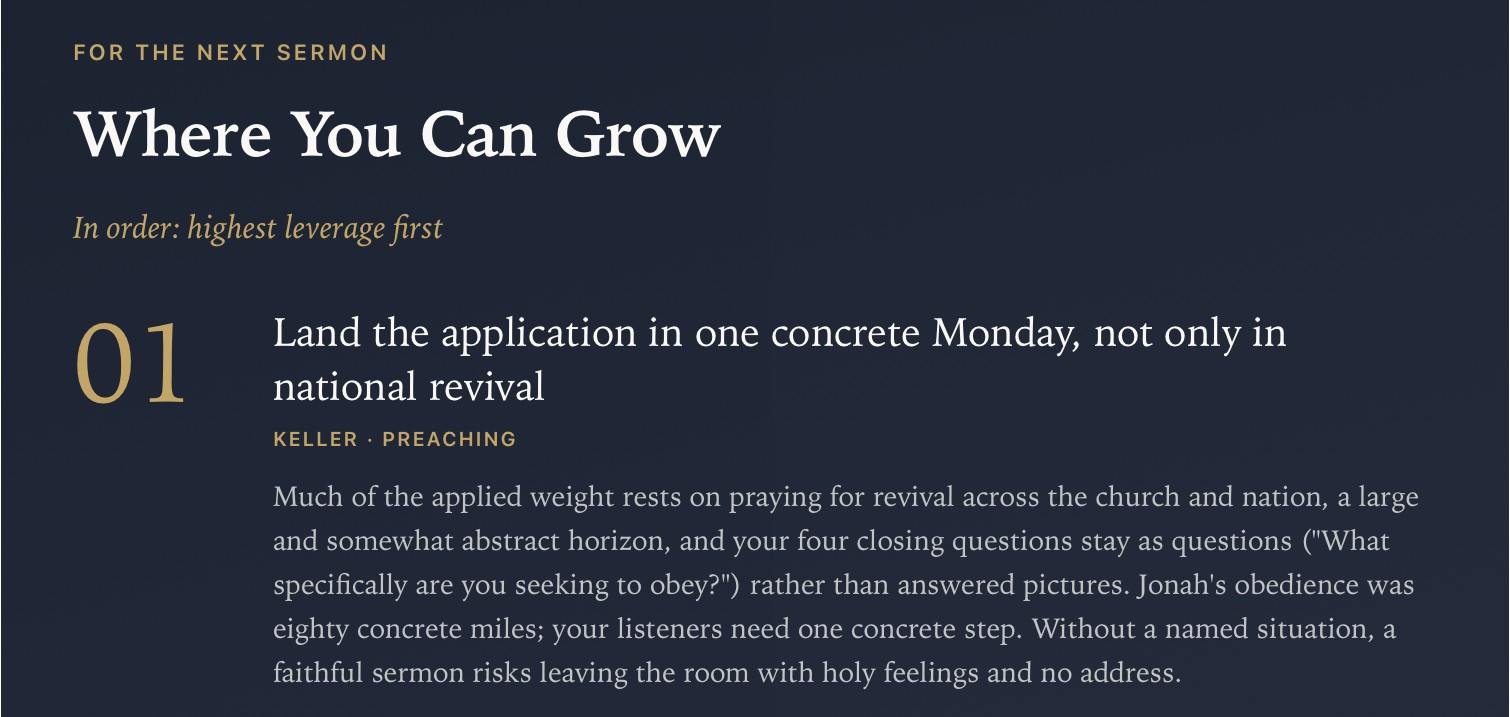
Every debrief ends with one direction for the next sermon and a rewrite of his own words showing what it looks like. This is the kind of thing you will sit down to talk about.
From the How To Grow section of a coaching debrief, the feedback an Apprentice preacher receives.
The preacher has his own account and a private library.
The mentoring relationship starts only when he accepts it.
What you can see follows the seat you chose.
You read his evaluations. His manuscripts stay his.
Preachers you mentor never see one another's sermons.
Your sermons are never used to train AI or shared outside the service.
When a relationship ends, any held evaluations are released to him.
Questions mentors ask
What is the difference between Apprentice and Colleague?
You read the full evaluation in both. The difference is how feedback reaches the preacher. On Apprentice he reads the coaching debrief and How It Preaches, and the scored evaluation waits for you to release it. On Colleague he reads everything right away.
Who sees the full evaluation?
You always do. A Colleague preacher sees it immediately. An Apprentice preacher sees it when you release it, and you can release any held evaluation whenever you judge it will help.
Who owns the sermon library?
The preacher. He submits his own sermons and keeps his own library. A seat gives you visibility. It does not give you ownership.
Do I see his manuscripts?
No. You read his evaluations, which quote the sermon where it matters. The manuscript stays in his account.
What happens when a seat is cancelled or reassigned?
The seat stays active through the end of your billing period. When it ends, the relationship closes, you no longer see his library, and any held evaluations are released to him. You can also end a relationship and invite a different preacher to the same seat.
Can a preacher continue on his own afterward?
Yes. His account, sermons, and evaluations stay with him. He can keep going on his own with a plan or a pack.
Does The Sermon Coach replace the mentor?
No. It gives you structured evidence and a consistent framework. You bring what software cannot: knowledge of the preacher, his congregation, his calling, and his character.
Do seat submissions use my own evaluations?
No. Each seat has its own monthly submissions. Your plan and packs stay yours, and unused seat submissions don't roll over.
Give the next mentoring conversation something concrete to work with.
The Sermon Coach is an independent tool. It is not affiliated with, endorsed by, or sponsored by Bryan Chapell, Tim Keller, John Piper, Haddon Robinson, the Simeon Trust, 9Marks, or any author, ministry, or organization whose published work informs its rubric. All names and works are referenced for identification and attribution only. None of these individuals or organizations, nor any author or teacher associated with them, has endorsed or is affiliated with The Sermon Coach.